
Every roll of kitchen paper that leaves a converting plant wraps a simple question: how does this product survive a 30-day ocean crossing, sit on a warehouse shelf, and still look retail-ready when the end buyer opens the carton? The answer lives in the packaging line, not the paper line. Get the packaging wrong and even the best embossed, highest-GSM roll arrives warped, moisture-damaged, or unsellable.
This guide walks through the three packaging formats used for kitchen tissue rolls in B2B export — shrink wrap, corrugated cartons, and custom printed packaging — with the specifications that importers and private-label buyers need to communicate to their factory before the first container loads.
Key Takeaways
- Three packaging layers protect kitchen tissue rolls in export: individual shrink wrap, inner carton dividers, and outer corrugated cartons on pallets.
- White-label orders ship from a 20GP container; custom printed packaging requires a 40-foot high-cube container as minimum order.
- Moisture-proof packing is non-negotiable for ocean freight — waterproof corrugated cartons, fumigation-free pallets, and high-tensile strapping are standard.
- Custom print packaging adds 5–7 working days to the 25–30 day first-production lead time for plate making and proof approval.
- Every shipment should include a COA (tensile strength, brightness, fiber verification), burst-resistance inspection video, and loading photos.
Why Packaging Format Drives Your Unit Cost More Than GSM
Most importers fixate on GSM and ply when comparing quotes. That is a mistake. The packaging format you specify determines how many rolls fit per carton, how many cartons stack per pallet, and how many pallets a 20GP or 40HQ container accepts. Those three variables set your landed cost per unit far more than a 2 GSM difference in paper weight.
A shrink-wrapped single roll in a retail header card takes up more carton volume per sheet of paper than a 6-pack wrapped in printed PE film. The paper cost is identical. The shipping cost per sellable unit is not. Before you request a quote, decide your packaging format — because the factory will tool differently for each one.
The Three Packaging Layers
Layer 1: Individual Roll Shrink Wrap
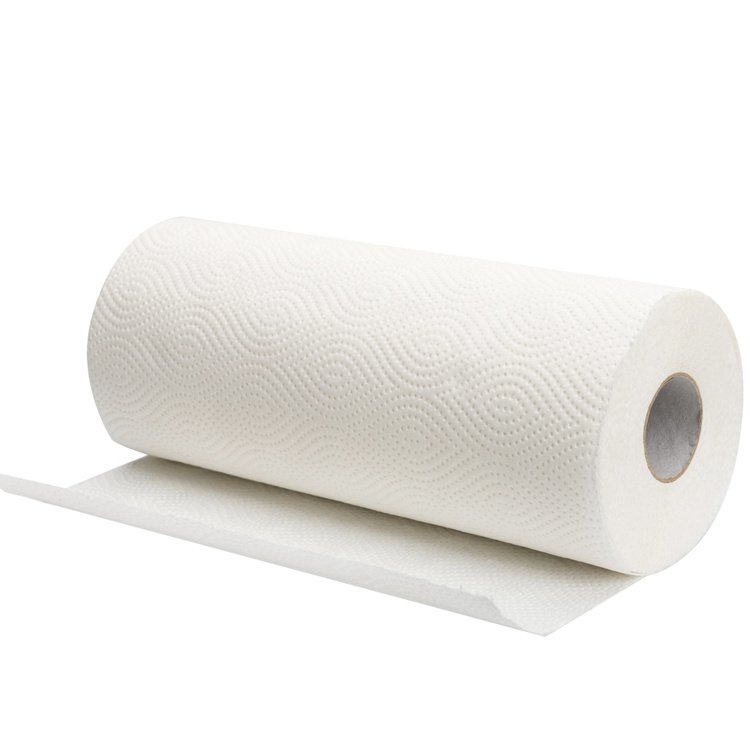
The innermost packaging layer is a PE or PP shrink film sleeve around each roll. This serves two purposes: it keeps the roll clean during handling and transit, and it provides the moisture barrier that prevents ambient humidity from reaching the paper surface. For food-contact applications — which kitchen paper towels are classified under — the film must comply with FDA 21 CFR Part 176 (for US-bound shipments) or EU Regulation 1935/2004 (for European markets).
The shrink film is applied after the roll exits the log saw. Roll diameter and length determine the film sleeve size. Standard kitchen rolls at 10–12 cm diameter and 20–25 cm length fit a common sleeve format; oversized rolls (up to 15 cm diameter for premium lines) need a wider sleeve and a different shrink tunnel setting. If you change roll diameter mid-order, the factory must retool the sleeve applicator — which adds downtime and cost.
Layer 2: Inner Carton Dividers and Multi-Packs
Inside the outer carton, rolls are grouped by inner packs — typically 2, 4, 6, or 8 rolls per inner. The inner pack format depends on your target retail channel:
- Retail shelf-ready: 2-pack or 4-pack with printed PE film or cardstock carrier, designed to hang on a peg board or sit on a shelf.
- Wholesale bulk: 6-pack or 8-pack in a simple corrugated divider, no print — the outer carton does the branding.
- Food-service: Individual rolls without inner packs, loaded directly into the outer carton for easy dispensing in commercial kitchens.
The divider material matters. Cardboard dividers add weight and cost but protect rolls from rubbing against each other. PE film inner wraps are lighter and cheaper but offer less crush protection. For long-distance ocean freight — say, Tianjin Xingang to West Africa or South America — cardboard dividers are the safer choice. The extra grams per carton are worth the reduction in damaged goods on arrival.
Layer 3: Outer Corrugated Carton
The outer carton is the shipping workhorse. For kitchen tissue roll export, the standard is a high-strength, waterproof corrugated box — typically 5-layer (double-wall) for rolls shipped on pallets, or 3-layer (single-wall) for hand-loaded containers. The waterproof treatment is essential. A container crossing the equator experiences temperature swings that create condensation inside the box — the so-called container rain problem. A non-waterproof carton softens, loses stack strength, and collapses under the weight of the pallets above it.
Carton dimensions are set by the inner pack format and the pallet pattern. A standard 1.0 x 1.2 m pallet (European size) or 1.0 x 1.0 m pallet (Asian export size) determines how many cartons fit per layer and how many layers stack. Your factory should provide a carton dimension drawing before you confirm the order — if they do not, that is a red flag.
White-Label vs Custom Printed Packaging: The MOQ Threshold
The packaging decision is also a commercial decision. Here is how the two routes differ at the order level:
| Parameter | White-Label / Plain | Custom Printed |
|---|---|---|
| MOQ | 1x 20GP container | 1x 40’HQ container |
| Outer carton | Plain brown or white, factory standard | Custom design, up to 4-color CMYK print |
| Inner pack wrap | Plain PE film or unprinted cardstock | Printed PE film or printed cardstock with your artwork |
| Shrink film | Clear, unprinted | Clear, unprinted (print on film not standard for rolls) |
| Lead time (first order) | 25–30 working days | 25–30 working days + 5–7 days for plate making |
| Reorder lead time | 20–25 working days | 20–25 working days (plates stored, no reprint fee) |
| Artwork file format | N/A | AI or PDF vector, with dieline from factory |
The 40-foot high-cube threshold for custom print exists because the printing plates and setup cost are amortized over the container volume. A 20GP holds roughly half the cartons of a 40HQ — the per-carton print cost doubles, which defeats the economics of custom packaging. If your market cannot fill a 40HQ, start with white-label and upgrade to custom print when your reorder volume justifies it.
One detail buyers often miss: your factory should store your private label design files permanently after the first order. Private label packaging workflows at established export factories include archival of your artwork and plate specs, so reorders ship without reprint plate charges. If a factory quotes you a plate fee on every reorder, walk away — that is a margin extraction, not a real cost.
Moisture-Proof Packing: The Ocean Freight Non-Negotiable
Kitchen paper towels are hygroscopic. The same 3D point-to-point embossing and wet-strength resin formula that gives them 40% better absorption performance also means the paper surface attracts moisture from humid air. In a sealed container crossing tropical waters, relative humidity inside the box can reach 80–90%. Without moisture-proof packing, the outer rolls in each carton develop water stains, the cardboard softens, and the shrink film traps condensation against the paper surface.
The standard moisture-proof protocol for kitchen tissue roll export includes:
- Waterproof corrugated cartons: Treated with a water-resistant sizing agent during board manufacturing. This is not the same as wax-coated (which is food-contact problematic) — it is a surface treatment that repels liquid water while allowing the board to breathe.
- Fumigation-free pallets: Heat-treated (ISPM-15 compliant) hardwood or engineered wood pallets that do not require chemical fumigation. This avoids the risk of chemical residue transferring to the paper product.
- High-tensile strapping: PET or steel strapping that holds the cartons firmly to the pallet without loosening during transit. Loose straps mean shifting cartons, which means crushed corners.
- Container seal inspection: Before loading, the factory or loading team checks the container for light leaks (pinholes in the roof), door seal integrity, and floor condition. A container with a compromised seal will let water in regardless of how good your carton treatment is.
Your factory should provide loading and moisture-proof packing photos or video before the container departs. This is standard deliverable from a qualified export operation — along with the full sourcing documentation package including COA and inspection reports. If the factory does not offer this proactively, request it in your purchase order terms.
Custom Print Specifications: What the Factory Needs From You
If you are ordering custom printed packaging for kitchen tissue rolls, the factory’s pre-press team needs three things from you before plate making begins:
1. Vector artwork in AI or PDF format. Raster images (JPEG, PNG) cannot be used for flexographic printing plates. Your artwork must be vector-based, with all text converted to outlines and all colors specified in Pantone or CMYK values. If you only have a raster logo, budget for a vector redraw.
2. Approval of the factory’s dieline. The dieline is the flat-pattern template that shows where the carton folds, glues, and cuts. Your artwork must fit within the dieline’s print area, with bleed zones and safe margins respected. The factory provides the dieline; you place your artwork within it. Never design packaging without the factory’s dieline — even a 3 mm shift can misalign a fold line with your artwork edge.
3. A signed physical proof. Before mass production, the factory produces one physical sample carton printed with your artwork. This is your last chance to catch color mismatches, spelling errors, or registration problems. Approve it in writing (a scanned signature on the proof itself is standard). Once you approve, the factory runs the full order to that standard — and any later changes require a new plate and a new proof.
Packaging Format and Container Loading
The packaging format you choose directly affects how many rolls fit in a container. Here is the relationship:
| Packaging Format | Typical Rolls per Carton | Cartons per 20GP (approx.) | Cartons per 40HQ (approx.) |
|---|---|---|---|
| Single roll, shrink-wrapped, no inner | 48–72 | 300–400 | 800–1,000 |
| 4-pack in printed PE film | 24–36 packs | 200–280 | 550–700 |
| 6-pack in cardboard divider | 16–24 packs | 150–200 | 400–500 |
These ranges depend on roll diameter, roll length, and carton dimensions — all of which vary by factory and by your specifications. The numbers above are representative for standard kitchen rolls (approximately 10 cm diameter, 22 cm length, 1-ply 15–18 GSM). Always ask your factory for a specific loading plan with your exact roll and carton dimensions before confirming the order.
For a deeper look at how container loading works across all tissue product categories, see our container loading guide for tissue paper.
Quality Control: What to Check Before the Container Seals
Packaging quality control is part of the factory’s 3-stage QC process:
- Stage 1 — Parent roll inspection: Tensile strength, brightness, and 100% virgin fiber verification via COA before the paper even enters the converting line.
- Stage 2 — In-process inspection: During converting, the factory checks GSM, tension, perforation quality, and embossing registration. This is also where shrink film application and inner pack assembly are monitored.
- Stage 3 — Final inspection: Finished cartons are checked for count accuracy, print registration (for custom orders), carton seal integrity, and pallet stacking pattern. A drop test on a sample carton verifies that the packaging survives handling.
The factory should provide three deliverables with every shipment: a COA report covering tensile strength, brightness, and fiber verification; a burst-resistance and quality inspection video; and loading plus moisture-proof packing photos or video. If any of these are missing from your shipment documentation, flag it before the container leaves the port.
Ordering Workflow: From Packaging Spec to Container Departure
Here is the sequence for a first-time custom printed kitchen tissue roll order:
- Week 1: Send your packaging requirements (roll size, inner pack format, outer carton print, quantity) to the factory. Receive a quote with FOB/CIF/CFR/EXW pricing.
- Week 2: Approve the quote. Send vector artwork. Receive the factory’s dieline and place your artwork within it.
- Week 3: Factory produces a physical proof carton. You approve or request corrections (allow 1–3 working days for proof round-trip).
- Weeks 3–6: Production. First-order lead time is 25–30 working days including plate making, printing, converting, and packing.
- Week 6: Final inspection, loading photos/video, container seal check. Container departs from Tianjin Xingang Port.
Reorders are faster: 20–25 working days, since plates are already stored and no new proof is needed unless you change the artwork.
Frequently Asked Questions
Can I use recycled cardboard cartons for kitchen tissue roll packaging?
For the outer shipping carton, recycled cardboard is acceptable and common. For any packaging that contacts the paper roll directly — inner dividers, shrink film, or inner pack wraps — the material must be food-contact safe and free from recycled fiber contaminants. The paper product inside is classified as food-contact safe, and the inner packaging must match that standard.
What happens if the custom print color does not match my brand standard?
This is what the physical proof is for. Before mass production, the factory sends you a printed sample carton. Compare it against your Pantone reference or brand guide. If the color is off, request a correction before approving. Once you sign off on the proof, the production run matches that proof — not your original digital file. Monitor lighting conditions when comparing, as color perception shifts under different light temperatures.
Do I need different packaging for domestic vs export shipping?
Export shipping — especially ocean freight in tropical routes — demands stronger moisture protection than domestic trucking. If the same factory supplies both your domestic and export markets, confirm that the export cartons receive waterproof treatment and that the pallet wrapping protocol meets ISPM-15 standards. Domestic shipments in climate-controlled trucks can use lighter packaging, but export cartons should always be specified for the worst-case humidity scenario.
How does packaging affect the per-roll landed cost?
Packaging adds material cost (carton, film, pallet), printing cost (for custom orders), and volume cost (bulkier packaging means fewer rolls per container). A plain shrink-wrapped roll in a brown carton adds less per-roll cost than a 4-pack in printed PE film with a custom carton. The difference is small per unit but compounds across a 40HQ container holding hundreds of thousands of rolls. Always compare quotes on a per-roll-landed-cost basis, not just per-carton price.