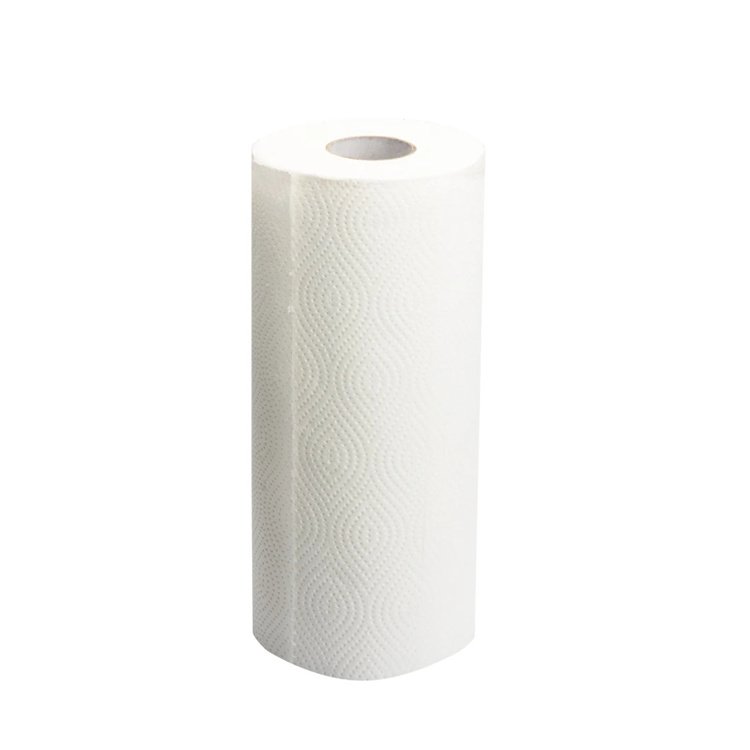
A retail buyer in Ohio walks down the paper towel aisle. Every box looks the same: white cardboard, blue and green branding, a promise of absorbency. She picks up a pack not because the brand convinced her, but because the price was right and the roll size fit her holder. That is how retail paper kitchen rolls are sold — on price and shelf position, not on specification literacy.
The importers who make money in this aisle are the ones who understand what is inside the package. GSM, perforation count, sheet size, wet-burst strength, and embossing pattern determine whether a kitchen roll performs or disappoints — and whether a retail buyer reorders or switches brands. This guide breaks down the three specs that matter most for retail paper kitchen rolls: GSM, perforation, and absorbency — and how to read a factory’s quote sheet against them.
Key Takeaways
- GSM (grams per square meter) is the single most influential spec for retail kitchen rolls — it determines softness, absorbency, and perceived quality. Standard retail range is 13–18 GSM per ply for 1-ply, or 13–15 GSM per ply for 2-ply.
- Perforation density (holes per roll) controls how easily sheets tear cleanly. Too few perforations cause jagged tears; too many weaken the sheet. Standard is 80–120 perforations per roll for a 22–25 cm sheet length.
- Absorbency is driven by embossing pattern and wet-strength resin, not just GSM. Point-to-point embossing with wet-strength resin delivers 40% better absorption than flat, unembossed tissue of the same weight.
- Retail buyers should request samples and test all three specs before placing a container order — the quote sheet alone does not reveal performance.
- All specs must use 100% virgin wood pulp for retail-grade kitchen rolls — recycled fiber produces visibly inferior absorbency and softness.
GSM: The Spec That Sets Your Retail Price Point
GSM measures the weight of paper per square meter. For kitchen rolls, it directly correlates with the product’s perceived quality and its absorbency capacity. Heavier paper holds more water, tears less during use, and feels more substantial in the consumer’s hand.
Here is how GSM maps to retail market segments:
| Segment | Ply | GSM per Ply | Total GSM | Retail Position |
|---|---|---|---|---|
| Economy | 1-ply | 13–14 | 13–14 | Budget chains, value packs |
| Standard | 1-ply | 15–17 | 15–17 | Mid-tier supermarket brands |
| Premium (1-ply) | 1-ply | 18–20 | 18–20 | High-absorbency single-ply |
| Standard (2-ply) | 2-ply | 13–15 | 26–30 | Mid-tier 2-ply brands |
| Premium (2-ply) | 2-ply | 15–18 | 30–36 | Top-tier retail brands |
The factory’s GSM range for kitchen paper towels covers 13–45 GSM across all product lines. For retail kitchen rolls specifically, the 13–20 GSM per ply range covers the vast majority of orders. Anything above 20 GSM per ply enters commercial/food-service territory where the product is sold on performance rather than price-per-roll.
One important detail: GSM is measured per ply, not per sheet. A 2-ply roll at 14 GSM per ply has a total sheet weight of 28 GSM. Some factories quote total GSM; others quote per-ply GSM. Always confirm which basis the factory is using before comparing quotes. A 2-ply roll quoted at 28 GSM total sounds identical to a 1-ply roll at 28 GSM — but they perform very differently because the 2-ply construction creates air pockets between layers that boost absorbency.
Perforation: The Invisible Quality Signal
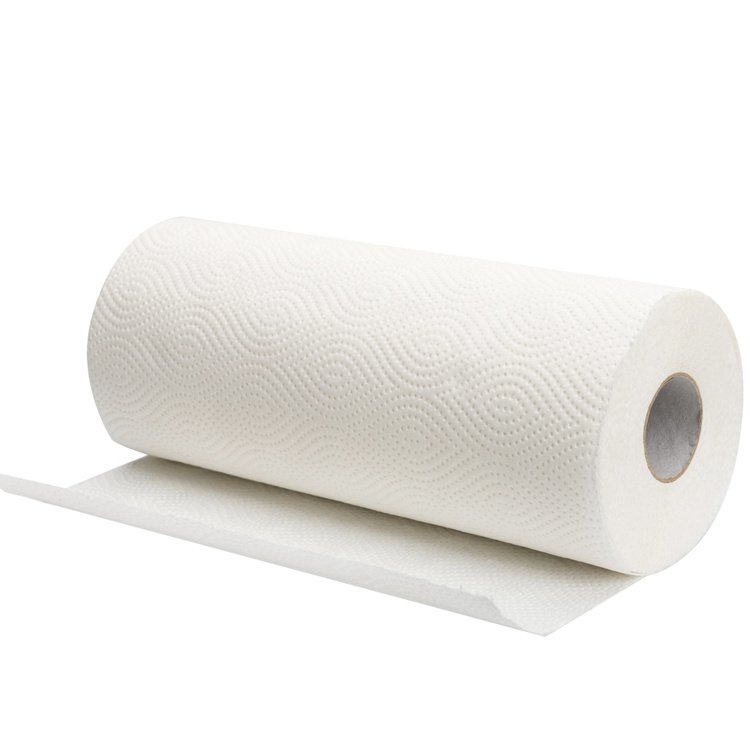
Perforation is the line of small holes punched into the paper at regular intervals, allowing the user to tear off individual sheets cleanly. It is the most overlooked spec in retail kitchen rolls — and the one that generates the most consumer complaints when done poorly.
Two variables define perforation quality:
Perforation density (count per roll). This is determined by the sheet length you specify. A 22 cm sheet length on a 25 m roll gives approximately 114 sheets (and 114 perforation lines). A 25 cm sheet length gives approximately 100 sheets. The perforation count must match the roll’s total meterage and the sheet length you have specified for your market.
Perforation depth and spacing. Each perforation line consists of a series of small cuts (micro-perforations) separated by uncut bridges. The ratio of cut-to-bridge determines how easily the sheet tears and how clean the tear edge is. Too much cut (deep perforations, short bridges) and the sheet detaches too easily — it falls off the roll during dispensing. Too little cut (shallow perforations, long bridges) and the user has to yank the roll, which can unspool the entire thing.
The standard for retail kitchen rolls is 80–120 perforations per roll, with micro-perforation depth calibrated to the paper’s GSM and ply. Higher-GSM paper needs deeper perforations because the fiber is denser. 2-ply paper needs perforations that penetrate both layers cleanly. The factory’s converting line adjusts perforation depth based on the specific product being run — this is part of the in-process QC check during converting.
Absorbency: It Is Not Just About GSM
Two kitchen rolls at the same GSM can have very different absorbency. The difference comes from two factors that GSM alone does not capture: embossing pattern and wet-strength resin.
Embossing pattern. The factory offers three embossing options relevant to kitchen rolls:
- Point-to-point (Deco) embossing: Creates a 3D diamond or quilted pattern that increases the paper’s surface area and creates capillary channels for water absorption. This is the highest-absorbency option and the standard for premium retail kitchen rolls.
- Edge embossing: Bonds the plies at the edges only, leaving the center loftier (thicker, more air space). This gives good bulk and softness but lower absorbency than point-to-point.
- Micro embossing: Fine surface texture that improves hand-feel without significantly affecting absorbency. More common in facial tissue than kitchen rolls.
For retail kitchen rolls, point-to-point embossing is the default for premium positioning. The 3D pattern is visible to the consumer (it looks like a quilted surface) and delivers measurably better water pickup than flat or edge-embossed tissue at the same GSM.
Wet-strength resin. Kitchen paper towels must not disintegrate when wet — a user needs to wipe a spill without the sheet falling apart in their hand. The factory’s wet-strength resin formula is applied during the papermaking process and gives the paper 40% better absorption performance while maintaining structural integrity when saturated. This is what separates a kitchen towel from a facial tissue: both are absorbent, but only the kitchen towel holds together during wet use.
The combination of point-to-point embossing and wet-strength resin is what delivers the absorbency that retail buyers specify in their product requirements. When comparing factory quotes, ask specifically about the embossing pattern and whether wet-strength resin is included — two rolls at the same GSM with different embossing and resin treatment will perform differently.
Retail-Specific Packaging and Roll Dimensions
For retail, the kitchen roll must fit standard household holders and packaging formats. The key dimensions:
- Roll diameter: 9–12 cm for standard retail. Oversized rolls (up to 15 cm) exist for premium lines but may not fit compact holders.
- Core diameter: 3.8 cm (1.5 inches) standard — this is the universal holder spindle size in North America and Europe.
- Sheet length: 22–25 cm standard for retail. Shorter sheets (18–20 cm) are used in some Asian markets.
- Sheets per roll: 60–120 depending on roll length and sheet size. Retail packaging must state the sheet count.
Packaging for retail is typically PE film wrap (shrink or sealed) with a printed header card or full-wrap label. The packaging must display the brand name, sheet count, ply, and any performance claims (e.g., “extra absorbent” or “2-ply strong”). For private-label retail orders, the packaging carries the retailer’s brand rather than the factory’s.
The MOQ for white-label retail kitchen rolls is 1x 20GP container. For custom printed packaging (retailer’s own brand), the MOQ is 1x 40’HQ container. First production lead time is 25–30 working days; reorders take 20–25 working days. Shipping is from Tianjin Xingang Port with full moisture-proof packing documentation.
How to Read a Factory Quote Against These Specs
When a factory sends you a price quote for retail kitchen rolls, the quote sheet should list:
| Spec Item | What to Check | Red Flag |
|---|---|---|
| Material | 100% virgin wood pulp | “Mixed pulp” or “recycled content” without disclosure |
| Ply | 1-ply or 2-ply as specified | Quote says 2-ply but price suggests 1-ply GSM |
| GSM | Per-ply GSM stated clearly | Only total GSM given (obscures ply count) |
| Embossing | Point-to-point for premium; edge for standard | No embossing specified (flat sheet = low absorbency) |
| Roll dimensions | Diameter, core size, sheet length, sheet count | Any dimension missing |
| Perforation | Standard micro-perforation, matched to sheet length | No mention of perforation |
| Packaging | PE film wrap, printed header card or full label | No packaging spec (unclear what you are paying for) |
If any of these items are missing from the quote, request clarification before proceeding. A factory that provides complete specifications on the quote sheet is a factory that controls its production process. One that leaves specs vague is one where quality depends on what the production team decides on the day.
For a broader view of how to evaluate a tissue paper factory’s capacity and QC systems before ordering, see our factory capacity and QC evaluation guide.
Sampling Before You Commit
Never place a container order based on a quote sheet alone. Request physical samples before committing — the factory provides sample production within 1–3 working days. Test the samples for:
- GSM verification: Weigh a known area of the sheet and calculate GSM. Compare against the quoted value. A ±1 GSM tolerance is acceptable; anything more indicates the factory is not hitting spec.
- Perforation test: Tear 10 sheets along the perforation. Count how many tear cleanly (no jagged edge, no double-tear) versus how many require a second attempt. Acceptable is 8 out of 10 or better.
- Absorbency test: Lay a sheet flat, drop 5 ml of water on it, and time how long it takes to fully absorb. Compare against your benchmark product. The factory’s wet-strength resin and point-to-point embossing should deliver fast absorption without the sheet breaking apart.
These three tests take five minutes and cost nothing. They reveal more about the product than any certificate.
Frequently Asked Questions
What GSM should I specify for a mid-tier retail kitchen roll?
For a 1-ply retail kitchen roll targeting the mid-tier supermarket segment, specify 15–17 GSM per ply with point-to-point embossing. This delivers good absorbency and perceived quality at a competitive cost. For 2-ply, specify 13–14 GSM per ply (26–28 GSM total) with the same embossing pattern.
Does higher GSM always mean better absorbency?
No. Absorbency is driven by the combination of GSM, embossing pattern, and wet-strength resin. A 14 GSM sheet with point-to-point embossing and wet-strength resin can outperform a 17 GSM flat sheet without resin. GSM determines the raw material volume; embossing creates the capillary structure that pulls water in; resin keeps the sheet intact while it absorbs. All three must work together.
Can I request a custom perforation pattern?
Yes. The factory adjusts perforation depth and spacing based on your sheet length and GSM specification. If you have a specific consumer complaint pattern (e.g., sheets tearing at the wrong place), send the factory a sample and they will adjust the perforation tooling to match your requirement.
What is the difference between retail and food-service kitchen rolls?
Retail rolls prioritize consumer-facing qualities: softness, attractive embossing, branded packaging, and competitive price-per-roll. Food-service rolls prioritize performance: higher wet-burst strength, larger sheet sizes, and bulk packaging without retail print. The same factory produces both, but the spec mix differs. Food-service kitchen rolls often use higher GSM (18–22 per ply) and heavier wet-strength resin treatment, while retail rolls optimize for visual appeal and cost efficiency.